
Discover effective ab exercises for beginners and experienced lifters. Learn proper technique, workout recommendations, and how to build a stronger core with a practical training plan.
Quick Answer: What Are the Best Ab Exercises?
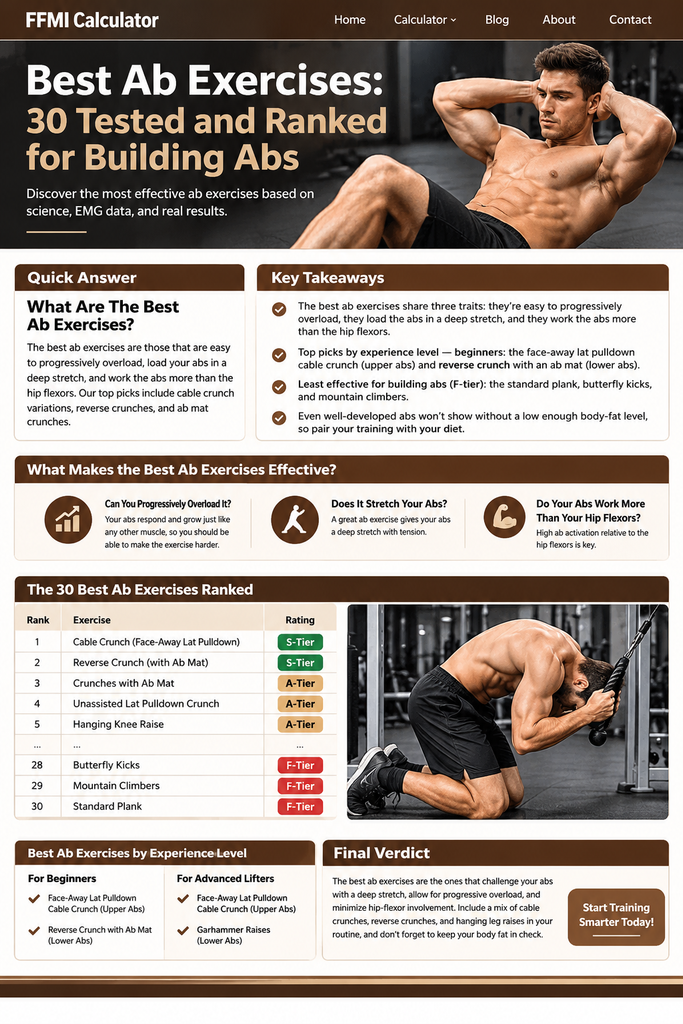
Some of the most useful exercises for building stronger abdominal muscles include cable crunches, reverse crunches, crunches with an ab mat, hanging knee raises, and ab-wheel rollouts. The right choice depends on your experience, available equipment, and ability to maintain proper form.
For muscle development, focus on controlled repetitions, gradually increasing the challenge, and training through a comfortable range of motion. Planks and dead bugs are also valuable for core stability, even though they serve a somewhat different purpose than weighted ab exercises.
Key Takeaways
- For abdominal muscle growth: Try cable crunches, reverse crunches, and weighted crunch variations.
- For beginners: Start with controlled crunches, dead bugs, and reverse crunches.
- For experienced lifters: Consider cable crunches, hanging knee raises, and ab-wheel rollouts when your technique is solid.
- For core stability: Planks and dead bugs help develop control and bracing.
- For visible abs: Ab training builds the muscles, while overall body composition also affects how clearly they show.
- For consistent progress: Use good technique and gradually increase repetitions, resistance, or movement difficulty.
What Makes an Ab Exercise Effective?
A useful abdominal exercise should match your training goal, allow you to maintain proper form, and provide enough challenge to improve over time.
1. Progressive Overload
Muscles need an increasing training challenge over time. You can progress by adding resistance, completing more controlled repetitions, or using a more demanding variation.
For example, once bodyweight crunches become easy, you may hold a light weight against your chest or move to cable crunches.
2. Controlled Range of Motion
Avoid rushing through repetitions or relying on momentum. During a crunch, focus on bringing your rib cage toward your pelvis rather than simply lifting your head and shoulders.
During reverse crunches, actively curl your pelvis upward instead of swinging your legs.
3. Proper Muscle Engagement
Your hip flexors can contribute substantially to movements such as leg raises. To emphasize your abdominal muscles, control the movement and avoid letting your lower back arch excessively.
4. Consistent Training
You do not need to train your abs every day. Start with two or three sessions per week, allow sufficient recovery, and adjust your workload according to your experience and overall training schedule.
The 15 Best Ab Exercises to Try
1. Cable Crunch
Best for: Progressive resistance and abdominal muscle development.
Kneel in front of a cable machine with a rope attachment. Keep your hips relatively stable, then curl your torso downward by bringing your rib cage toward your pelvis.
Training tip: Begin with a manageable weight and increase resistance only when you can complete the movement without pulling with your arms or swinging your hips.
2. Reverse Crunch
Best for: Practicing controlled pelvic movement.
Lie on your back with your knees bent. Brace your core and curl your pelvis upward, bringing your knees slightly toward your chest. Lower slowly without swinging your legs.
Training tip: Keep the movement small and controlled. Lifting your hips with momentum reduces your control over the exercise.
3. Crunch With an Ab Mat
Best for: Adding a greater range of spinal movement to a crunch.
Position an ab mat beneath your lower back. Lower your upper body under control, then curl forward by contracting your abdominal muscles.
Training tip: Keep your neck relaxed and avoid pulling your head forward with your hands.
4. Standard Crunch
Best for: Beginners learning abdominal flexion.
Lie on your back with your knees bent and feet flat. Raise your shoulders slightly from the floor while bringing your rib cage toward your pelvis.
Training tip: You do not need to sit all the way up. Concentrate on a controlled abdominal contraction.
5. Hanging Knee Raise
Best for: Training the core while hanging from a bar.
Hang from a secure pull-up bar and raise your knees toward your torso. Lower them slowly without swinging.
Training tip: As you become comfortable, focus on gently curling your pelvis upward at the top of the movement.
6. Captain’s Chair Knee Raise
Best for: People who prefer additional upper-body support.
Rest your forearms on the pads and support your back against the backrest. Raise your knees, control the descent, and avoid swinging.
Training tip: Keep your torso stable and use a range of motion that you can control comfortably.
7. Ab-Wheel Rollout
Best for: Advanced core control and resistance to lower-back extension.
Kneel with the ab wheel beneath your shoulders. Roll forward slowly while keeping your abdominal muscles braced. Return to the starting position without allowing your lower back to sag.
Training tip: Start with short rollouts. Increase the distance only while you can maintain a stable torso.
8. Forearm Plank
Best for: Core endurance and trunk stability.
Place your forearms on the floor, extend your legs, and maintain a straight line through your body. Keep your abdominal muscles engaged and avoid letting your hips drop.
Training tip: Begin with manageable holds instead of extending the duration at the expense of technique.
9. Side Plank
Best for: Lateral core strength.
Lie on your side and support your body on one forearm. Lift your hips and keep your shoulders, hips, and legs aligned.
Training tip: Use a bent-knee variation if a full side plank is too difficult.
10. Dead Bug
Best for: Beginners learning to control their trunk and lower back.
Lie on your back with your arms extended upward and your knees bent. Slowly extend one arm and the opposite leg while keeping your trunk stable. Return to the starting position and switch sides.
Training tip: Shorten the movement if your lower back begins to arch away from the floor.
11. Bicycle Crunch
Best for: Practicing coordinated trunk rotation.
Lie on your back and bring one shoulder toward the opposite knee while extending the other leg. Alternate sides with controlled movements.
Training tip: Rotate through your torso instead of pulling your elbows toward your knees.
12. Mountain Climbers
Best for: Combining core control with conditioning.
Start in a high-plank position. Bring one knee forward, return it, and alternate legs while maintaining a stable upper body.
Training tip: Choose a pace that allows you to maintain proper plank position throughout the set.
13. Lying Leg Raise
Best for: Training the core during controlled leg movement.
Lie on your back and raise your legs within a comfortable range. Lower them slowly while preventing excessive arching of the lower back.
Training tip: Bend your knees or reduce the lowering distance if you cannot keep your trunk stable.
14. V-Up
Best for: A more demanding bodyweight abdominal exercise.
Lie on your back with your arms extended overhead. Raise your torso and legs toward each other, then lower under control.
Training tip: Use a smaller range or a bent-knee variation if the full movement causes you to swing or lose control.
15. RKC Plank
Best for: A more challenging isometric core exercise.
Set up in a forearm-plank position. Gently pull your elbows toward your feet without moving them, and tighten your glutes and abdominal muscles.
Training tip: Keep each hold relatively short while maintaining full-body tension and proper alignment.
Which Ab Exercises Are Best for Beginners and Advanced Lifters?
Best Ab Exercises for Beginners
If you are new to direct abdominal training, start with exercises that are easy to learn and modify.
- Standard crunch
- Reverse crunch
- Dead bug
- Forearm plank
- Side plank
These movements help you develop basic abdominal control, learn proper bracing, and build consistency before progressing to more demanding exercises.
Best Ab Exercises for Advanced Lifters
Experienced trainees can incorporate more resistance and challenging movement variations.
- Cable crunch
- Weighted crunch
- Hanging knee raise or leg raise
- Ab-wheel rollout
- RKC plank
Advanced exercises are not automatically better. Choose movements that challenge you without compromising your technique.
A Simple Ab Workout Plan
Use this sample routine two or three times per week, depending on your current training schedule and recovery.
| Exercise | Sets | Repetitions or duration |
|---|---|---|
| Cable crunch or standard crunch | 3 | 10–15 reps |
| Reverse crunch | 3 | 10–15 reps |
| Dead bug | 2 | 8–12 per side |
| Forearm plank | 2 | 20–45 seconds |
Rest approximately 45–90 seconds between sets, or longer if needed to maintain good technique.
How to progress: When you can complete every set comfortably with controlled form, gradually add resistance, repetitions, or time. You do not need to increase everything at once.
Beginners can start with two exercises and build up as their strength and confidence improve.
Can You Target Upper and Lower Abs Separately?
The rectus abdominis is one continuous muscle running along the front of your abdomen. You cannot completely isolate separate upper and lower abdominal muscles.
However, different movements emphasize different actions. Crunches focus on spinal flexion, while reverse crunches emphasize curling the pelvis. Both can train the abdominal muscles, although the amount of involvement varies with technique and exercise selection.
For a balanced routine, combine a controlled crunch variation with a reverse crunch or another movement that suits your ability.
Are Sit-Ups Better Than Crunches?
Neither exercise is automatically best for everyone.
Sit-ups involve a larger movement and generally require more contribution from the hip flexors. Crunches focus more directly on spinal flexion and may be easier to control for someone who wants to emphasize the abdominal muscles.
Choose the movement that fits your goals, feels comfortable, and allows you to progress without pain. You can also use cable or weighted variations when bodyweight exercises become too easy.
How Do You Make Your Abs More Visible?
Abdominal exercises can strengthen and develop your abs, but they cannot selectively remove fat from your stomach.
Visible abdominal definition depends on several factors, including overall body-fat levels, abdominal muscle development, genetics, and how fat is distributed throughout your body.
For a practical approach:
- Train your whole body consistently.
- Include direct abdominal exercises in your routine.
- Eat a balanced diet with adequate protein.
- Maintain an appropriate calorie intake for your goal.
- Get enough sleep and allow time for recovery.
Avoid extreme dieting or trying to reach an unnecessarily low body-fat level just to make your abs more visible.
Frequently Asked Questions
1. What is the best exercise for building abs?
Cable crunches, weighted crunches, and controlled reverse crunches are useful options. The best choice depends on your technique, experience, equipment, and ability to increase the training challenge over time.
2. How often should I train abs?
Two or three sessions per week is a reasonable starting point for many people. Adjust your training according to recovery, exercise intensity, and your overall workout program.
3. Can I build abs without gym equipment?
Yes. Crunches, reverse crunches, dead bugs, and planks can all be performed at home. As you get stronger, choose more challenging variations or add resistance safely.
4. Are planks enough to build abs?
Planks help develop core endurance and stability. However, combining them with controlled abdominal movements can provide a broader training stimulus if your goal includes abdominal muscle development.
5. Do leg raises target the lower abs?
Leg raises train the abdominal muscles and hip flexors together. Adding controlled pelvic movement can increase the abdominal contribution, but no exercise completely isolates the lower portion of the rectus abdominis.
6. How long does it take to see ab definition?
There is no fixed timeline. Results depend on your starting body composition, training history, nutrition, genetics, and consistency. Focus on sustainable progress rather than promising a particular result within a set number of days.
7. Do I need to train abs every day?
No. Daily abdominal training is not necessary for most people. Consistent sessions, appropriate recovery, and gradual progression are more useful than simply increasing training frequency.
Final Thoughts
The best ab workout is one you can perform consistently with proper technique and gradually make more challenging. Start with manageable movements, combine abdominal flexion with core-stability exercises, and progress as your ability improves.
Remember that strong abdominal muscles and visible abs are related but different goals. Training develops the muscles, while overall body composition also influences their appearance.
Build your routine around consistency, good form, and realistic expectations rather than searching for a single exercise that promises instant results.