
ZonePro
What Is a Heart Rate Zone Calculator?
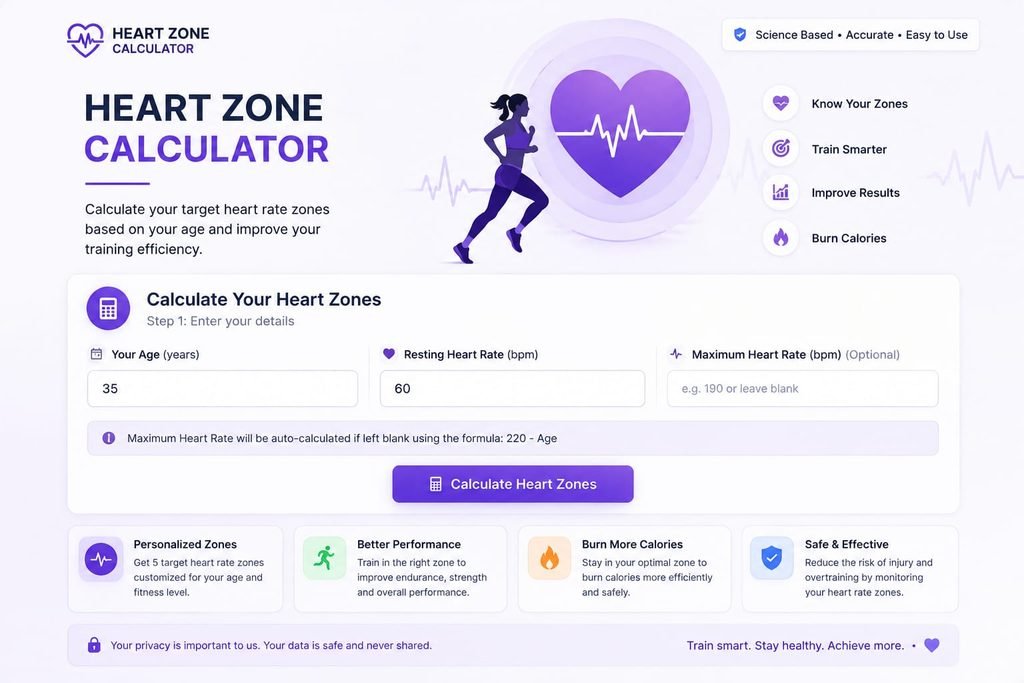
A heart rate zone calculator is a tool that helps you determine your ideal heart rate ranges for different levels of exercise. By using information such as your age, resting heart rate, and maximum heart rate, the calculator can estimate your personalized heart rate zones.
Heart rate zones are commonly divided into five levels, ranging from very light activity to high-intensity exercise. Each zone represents a different percentage of your maximum heart rate and can be useful for different training goals.
For example, Zone 2 is commonly associated with low-to-moderate intensity aerobic exercise, while higher zones are used for more intense workouts. Training within the appropriate zone can help you control workout intensity and structure your cardio training more effectively.
A heart rate zone calculator provides an easy way to understand these ranges without manually performing the calculations. However, calculated zones are estimates, and individual heart rate responses can vary.
Your maximum heart rate (Max HR or MHR) is the highest number of beats per minute your heart can safely reach during intense physical exertion. It’s the foundation for almost every heart rate zone calculation, target heart rate chart, and training zone calculator you’ll come across.
How to Calculate Your Max Heart Rate
The most common and simplest formula used to calculate maximum heart rate is:
Max HR = 220 − Age
So if you’re 30 years old, your estimated max heart rate would be 190 bpm. This is the classic “age predicted max heart rate” formula, and it’s still the most widely used method in fitness apps, heart rate zone calculators, and gym equipment.
However, this formula is a general estimate, not a precise medical measurement. Because of that, several alternative formulas have been developed to improve accuracy:
- Tanaka Formula: Max HR = 208 − (0.7 × Age) — considered more accurate for older adults and often used in exercise science research.
- Gulati Formula (commonly used for women): Max HR = 206 − (0.88 × Age)
Different max heart rate calculators by age and gender may use slightly different versions of these formulas, which is why you might see a small variation between apps like Garmin, Apple Watch, or Polar.
Max Heart Rate by Age Chart
| Age | Estimated Max HR (220-Age) |
|---|---|
| 20 | 200 bpm |
| 25 | 195 bpm |
| 30 | 190 bpm |
| 35 | 185 bpm |
| 40 | 180 bpm |
| 45 | 175 bpm |
| 50 | 170 bpm |
| 55 | 165 bpm |
| 60 | 160 bpm |
| 65 | 155 bpm |
| 70 | 150 bpm |
Keep in mind, the highest heart rate ever recorded during intense exercise can vary quite a bit between individuals — genetics, fitness level, and even medication can all shift your true max heart rate up or down from the formula’s estimate. The only way to know your exact max heart rate is through a supervised maximal exercise test, but for everyday training, the age-based formula works well enough.
Understanding Heart Rate Zones
Once you know your max heart rate, you can divide it into training zones — ranges of intensity that correspond to different training effects. Most heart rate zone charts break training into five zones:
| Zone | % of Max HR | Description |
|---|---|---|
| Zone 1 | 50–60% | Very light / warm-up / recovery |
| Zone 2 | 60–70% | Light aerobic / fat-burning / base building |
| Zone 3 | 70–80% | Moderate / aerobic endurance |
| Zone 4 | 80–90% | Hard / threshold / anaerobic |
| Zone 5 | 90–100% | Maximum effort / VO2 max |
This is the basic “5 heart rate zones” model used by most heart rate zone calculators, whether you’re using Garmin, Strava, Polar, or a generic fitness app.
How Heart Rate Zone Calculators Work
A heart rate zone calculator typically asks for your age (to estimate max HR) and sometimes your resting heart rate, then multiplies your max HR by the percentage ranges above to give you a personalized heart rate zone chart. Apple Watch, Garmin, and Strava heart rate zones all use variations of this same underlying math, though some (like Garmin) allow manual entry of a lab-tested max HR for more precision.
Zone 2 Heart Rate: Why It’s Become So Popular
Zone 2 training has exploded in popularity, especially with the rise of the “80/20 calculator” method used by endurance athletes — where roughly 80% of training volume happens in Zone 2 (easy, aerobic effort) and only 20% happens at higher intensities.
How to Calculate Your Zone 2 Heart Rate
Using the basic percentage method:
Zone 2 = 60–70% of Max HR
For a 30-year-old with a max HR of 190 bpm:
- Zone 2 range = 114–133 bpm
What Does Zone 2 Feel Like?
Zone 2 is the “conversational pace” zone — you should be able to hold a conversation without gasping for air. It’s a light-to-moderate effort that builds your aerobic base, improves fat metabolism, and increases mitochondrial density over time. This is why so many runners, cyclists, and general fitness enthusiasts are now asking “what is my zone 2” or searching for a “zone 2 heart rate calculator by age” — it’s considered one of the most valuable (and most underused) training zones for long-term endurance and metabolic health.
If you’re 30 years old, your zone 2 heart rate will typically fall between roughly 114–133 bpm using the simple percentage method, though the Karvonen method (explained below) often gives a more personalized number.
The Karvonen Formula (Heart Rate Reserve Method)
While the basic percentage-of-max-HR method is simple, it doesn’t account for your individual fitness level. That’s where the Karvonen Formula — also called the Heart Rate Reserve (HRR) method — comes in.
Karvonen Formula Explained
Heart Rate Reserve (HRR) = Max HR − Resting HR
Target HR = [(HRR) × %Intensity] + Resting HR
Example:
- Max HR = 190
- Resting HR = 60
- HRR = 190 − 60 = 130
- Target zone at 70% intensity = (130 × 0.70) + 60 = 151 bpm
The Karvonen method is generally considered more accurate than the simple percentage method because it factors in your resting heart rate, which reflects your current cardiovascular fitness. Someone with a lower resting heart rate (a sign of good aerobic fitness) will get a different — usually higher — target zone than someone with a higher resting heart rate, even if their max HR is identical.
This is the formula behind most serious training zone calculators used by runners and cyclists, including many cycling-specific HRR zone calculators.
How to Calculate Resting Heart Rate
Your resting heart rate (RHR) is your heart rate when you’re completely at rest — ideally measured first thing in the morning before getting out of bed.
How to measure it:
- Use a heart rate monitor, fitness tracker, or simply place two fingers on your wrist or neck pulse point.
- Count the beats for 60 seconds (or count for 15 seconds and multiply by 4).
- Take the measurement at the same time each day for a few days and average the results for accuracy.
A normal resting heart rate for most adults falls between 60–100 bpm, though well-trained athletes often have resting heart rates in the 40–60 bpm range. A lower resting heart rate is generally a sign of good cardiovascular fitness.
Target Heart Rate for Fat Burning & Weight Loss
Many people search for a “fat burning heart rate zone calculator” hoping to find the exact intensity that maximizes calorie and fat burn. Here’s the truth: your body burns a higher percentage of calories from fat at lower intensities (like Zone 2), but you burn more total calories overall at higher intensities — so the “best” zone for weight loss depends on your goals and how long you can sustain the effort.
General fat-burning heart rate zone: 60–70% of Max HR (same as Zone 2)
General cardio/calorie-burning zone: 70–85% of Max HR
If your primary goal is fat loss, a combination of both — steady Zone 2 sessions plus occasional higher-intensity intervals — tends to be the most effective and sustainable long-term approach, rather than sticking to a single “magic” fat-burning zone.
Target Heart Rate by Age Chart (Cardio & Exercise)
| Age | Target HR Zone (50–85% of Max HR) | Average Max HR |
|---|---|---|
| 20 | 100–170 bpm | 200 bpm |
| 30 | 95–162 bpm | 190 bpm |
| 40 | 90–153 bpm | 180 bpm |
| 50 | 85–145 bpm | 170 bpm |
| 60 | 80–136 bpm | 160 bpm |
| 70 | 75–128 bpm | 150 bpm |
This chart is a general guideline — always adjust based on your fitness level, how you feel during exercise, and (ideally) guidance from a healthcare provider if you have any underlying heart conditions.
Running Heart Rate Zones
Runners often use heart rate zones slightly differently than the general fitness population, tying each zone to training purpose:
- Zone 1 (Recovery runs): Very easy, active recovery
- Zone 2 (Easy/Base runs): The bulk of weekly mileage — builds aerobic base
- Zone 3 (Steady/Tempo): Comfortably hard, marathon-pace effort
- Zone 4 (Threshold): Hard, lactate threshold pace — sustainable for ~20–60 minutes
- Zone 5 (VO2 Max/Intervals): All-out effort for short intervals
Most running apps and GPS watches (Garmin, Strava, Coros) calculate these zones automatically once you input your age or complete a max heart rate test, and many now also factor in lactate threshold heart rate (LTHR) for more precise zone boundaries — particularly useful for runners following structured plans.
Cycling Heart Rate Zones & Power Zones
Cyclists commonly use heart rate zones alongside (or instead of) power-based training zones like FTP (Functional Threshold Power). While an FTP zone calculator uses wattage rather than heart rate, many cyclists still rely on HRR (Karvonen) zones for endurance rides, since heart rate responds more slowly than power and is better suited to longer, steady efforts.
A typical cycling heart rate zone breakdown mirrors the general 5-zone model but is often fine-tuned using a cyclist’s tested lactate threshold heart rate rather than estimated max HR, since cycling-specific fitness can create a different HR response than running.
Lactate Threshold Heart Rate (LTHR)
Your lactate threshold is the point during exercise where lactate starts accumulating in your bloodstream faster than your body can clear it — essentially, the effort level you can only sustain for a limited time before fatigue sets in rapidly.
How to estimate LTHR:
- A common field test: run or cycle at a hard, sustainable effort for 20–30 minutes, then take your average heart rate for the final 20 minutes. This is a reasonable estimate of your lactate threshold heart rate.
- LTHR zones are then calculated as percentages of this threshold number, similar to how Max HR zones work — but many athletes find LTHR-based zones more accurate since it’s based on an actual test rather than an age-based formula.
Once you know your LTHR, most zone calculators will break your training into 5–7 zones relative to that number instead of your max heart rate.
Heart Rate Recovery
Heart rate recovery (HRR — not to be confused with Heart Rate Reserve) measures how quickly your heart rate drops after you stop exercising. It’s considered a strong indicator of cardiovascular fitness.
How to calculate it:
- Note your heart rate at the peak of exercise.
- Stop and note your heart rate exactly 1–2 minutes later.
- Subtract the second number from the first.
A drop of 12+ bpm within the first minute after stopping exercise is generally considered a healthy sign of good cardiovascular fitness. A smaller drop may indicate lower fitness or, in some cases, warrant a conversation with a doctor.
How Fitness Devices Calculate Heart Rate Zones
- Garmin: Uses age-based Max HR by default but allows manual entry of a lab-tested Max HR or LTHR for more accurate zones.
- Apple Watch: Calculates zones using the standard 220-minus-age formula unless you manually adjust it in the Health app.
- Strava: Pulls heart rate zone settings from your connected device or allows manual zone entry based on your own Max HR or LTHR.
- Polar: Offers its own proprietary “OwnZone” feature that personalizes zones based on real-time heart rate response during a short warm-up, rather than relying solely on the age-based formula.
Quick Reference: Common Heart Rate Formulas
| Formula | Equation |
|---|---|
| Max HR (standard) | 220 − Age |
| Max HR (Tanaka) | 208 − (0.7 × Age) |
| Max HR (Gulati, women) | 206 − (0.88 × Age) |
| Heart Rate Reserve (HRR) | Max HR − Resting HR |
| Karvonen Target HR | [(HRR) × %Intensity] + Resting HR |
| Zone 2 (basic) | 60–70% of Max HR |
| Fat-Burning Zone | 60–70% of Max HR |
| Cardio Zone | 70–85% of Max HR |
Final Thoughts
Whether you’re calculating your max heart rate for the first time, trying to nail down your Zone 2 range for aerobic base training, or using the Karvonen formula to personalize your heart rate reserve zones, the key takeaway is this: age-based formulas are a great starting point, but real fitness data — resting heart rate, lactate threshold, and how your body actually responds to training — will always give you a more accurate picture over time.
Start with the standard formulas above, track how you feel and perform in each zone, and adjust as your fitness improves. And if you have any pre-existing heart conditions or concerns, it’s always worth checking with a doctor before starting a new heart-rate-based training program.