Have you ever trained consistently, built serious muscle, and felt stronger than ever, only to find that your Body Mass Index (BMI) labels you as “overweight”? This is a common experience among fitness enthusiasts and athletes. BMI looks at your total body weight without considering how much of that weight comes from muscle.
The FFMI vs BMI comparison offers a better way to understand this difference. The Fat-Free Mass Index (FFMI) focuses on your lean body mass instead of your total weight. As a result, it can provide more useful information about muscularity and body composition. In this guide, we explain FFMI vs BMI, how both measurements work, and which one may be more useful for active people.
What Is BMI?
Body Mass Index, or BMI, is a simple measurement that compares your body weight with your height. The standard BMI formula is:
BMI = Weight (kg) ÷ Height² (m)
BMI is commonly used to classify people into categories such as underweight, healthy weight, overweight, and obesity. It can provide a quick screening measure for large populations.
However, BMI does not distinguish between muscle mass and body fat. Muscle is denser than fat, so a muscular person can have a high BMI even when they have a relatively low body-fat percentage.
For example, a person who lifts weights regularly may have a BMI that falls into the overweight category because of their higher muscle mass. This limitation is one reason why the FFMI vs BMI comparison is useful for athletes and people who have developed significant muscle.
What Is FFMI?
FFMI stands for Fat-Free Mass Index. It estimates the amount of fat-free mass a person carries relative to their height.
Fat-free mass includes:
- Muscle
- Bone
- Organs
- Water
- Other lean tissues
Unlike BMI, FFMI takes body-fat percentage into account. This allows you to estimate how much of your body weight is fat-free mass.
The basic FFMI formula is:
FFMI = Fat-Free Mass ÷ Height²
To calculate fat-free mass, you first need your body weight and body-fat percentage.
Because FFMI considers lean mass, it can provide a more useful view of muscularity than BMI for people who exercise regularly.
FFMI vs BMI — Key Differences
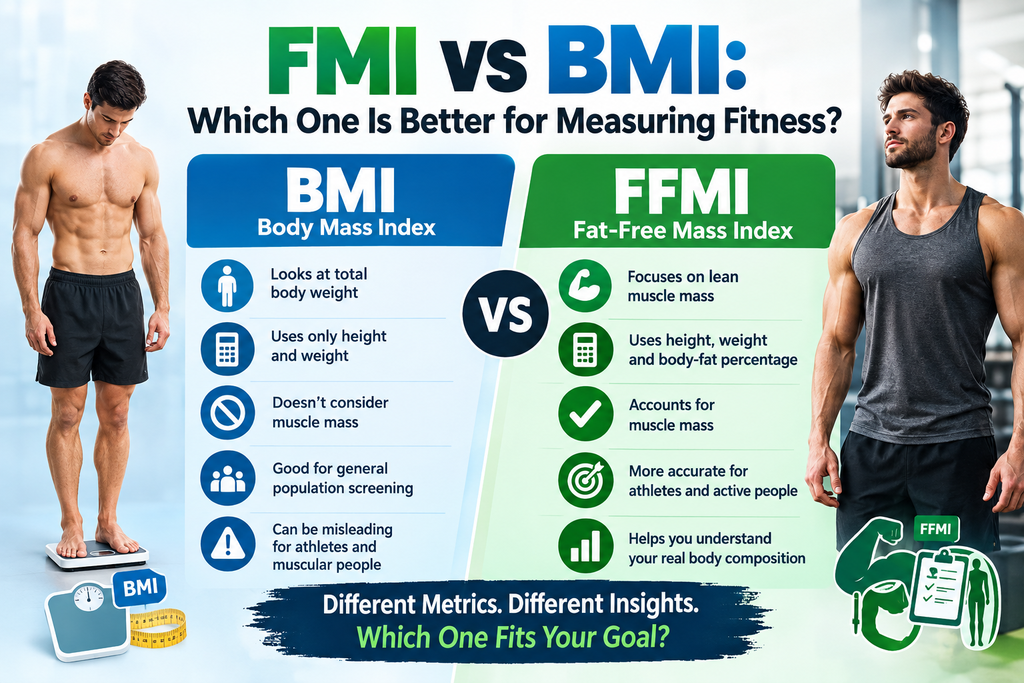
The main difference in the FFMI vs BMI comparison is what each measurement focuses on.
| Feature | Body Mass Index (BMI) | Fat-Free Mass Index (FFMI) |
|---|---|---|
| Primary focus | Total body weight relative to height | Fat-free mass relative to height |
| Uses body-fat percentage | No | Yes |
| Considers muscle mass | No | Yes |
| Useful for athletes | Limited | More useful |
| Required measurements | Height and weight | Height, weight, and body-fat percentage |
| Main purpose | General health screening | Lean mass and muscularity assessment |
BMI provides a broad picture of body weight, while FFMI provides more information about lean mass.
This difference becomes especially important when comparing people with different levels of muscle mass.
FFMI vs BMI Example
Consider a 6-foot-tall athlete who weighs 220 pounds and has 10% body fat.
His BMI would be approximately 29.8, which falls within the overweight category according to standard BMI classifications.
However, his body composition tells a different story. Because he has a relatively low body-fat percentage and substantial lean mass, his FFMI would be much higher than that of a person with the same height and weight but significantly more body fat.
Now imagine another 6-foot-tall person who also weighs 220 pounds but has 30% body fat. Both people have the same BMI because BMI only considers height and weight.
Their FFMI results, however, would be very different.
This example shows why FFMI vs BMI can provide a useful comparison for understanding body composition. Two people can have the same BMI while having very different amounts of muscle and body fat.
When Should You Use BMI?
BMI can still be useful in many situations. It provides a simple way to screen body weight across large populations.
For someone who does not exercise regularly and does not have a high level of muscularity, BMI can offer a useful starting point for understanding weight-related health risks.
However, BMI has limitations. It should not be treated as a complete measurement of body composition because it does not show how much of your weight comes from muscle or fat.
When Should You Use FFMI?
FFMI can be particularly useful if you:
- Lift weights regularly
- Participate in strength training
- Play sports
- Have a muscular build
- Want to track changes in lean mass
- Want to understand your muscularity
The FFMI vs BMI comparison becomes especially relevant when a person’s high body weight comes partly from developed muscle.
FFMI does not replace every health measurement, but it can provide additional information that BMI cannot.
How to Calculate FFMI
Calculating FFMI requires three basic measurements:
- Body weight
- Height
- Body-fat percentage
Step 1: Measure Your Body Weight
Record your current weight in kilograms. If your scale uses pounds, convert your weight to kilograms before using the metric formula.
For more consistent results, measure your weight under similar conditions each time.
Step 2: Measure Your Height
Measure your height accurately and record it in meters.
For example:
5 feet 11 inches ≈ 1.80 meters
Accurate height is important because height is part of the FFMI formula.
Step 3: Determine Your Body-Fat Percentage
You also need an estimate of your body-fat percentage.
Common methods include:
- DEXA scan
- Skinfold measurements
- BIA body-fat scales
- Body-fat estimation charts
Keep in mind that body-fat measurements are estimates. The accuracy of your FFMI result depends partly on the accuracy of your body-fat measurement.
Step 4: Calculate Fat-Free Mass
First, calculate your fat mass:
Fat Mass = Body Weight × (Body Fat % ÷ 100)
Then calculate your fat-free mass:
Fat-Free Mass = Body Weight − Fat Mass
For example, if you weigh 80 kg and have 15% body fat:
Fat Mass = 80 × 0.15 = 12 kg
Fat-Free Mass = 80 − 12 = 68 kg
Your estimated fat-free mass is therefore 68 kg.
Step 5: Calculate Your FFMI
Now use the FFMI formula:
FFMI = Fat-Free Mass ÷ Height²
Using the example above:
FFMI = 68 ÷ (1.80 × 1.80)
FFMI = 68 ÷ 3.24
FFMI = 20.99
Your FFMI would therefore be approximately 21.0.
What Is Normalized FFMI?
Normalized FFMI adjusts your FFMI based on height. This adjustment can make comparisons between people of different heights more useful.
A commonly used formula is:
Normalized FFMI = FFMI + 6.1 × (1.8 − Height)
For someone who is exactly 1.80 meters tall, there is no adjustment. Therefore, an FFMI of 21.0 remains approximately 21.0 after normalization.
Calculate Your FFMI Instantly
You do not have to calculate FFMI manually. Our FFMI Calculator can help you estimate your score using your height, weight, and body-fat percentage.
Enter your measurements into the calculator to get your FFMI result quickly.
FFMI vs BMI for Athletes
For athletes and people who regularly strength train, the FFMI vs BMI comparison can be especially helpful.
BMI only considers weight and height. Therefore, it cannot tell whether a person’s higher weight comes from muscle, fat, or a combination of both.
FFMI adds body-fat information and focuses on fat-free mass. This makes it more informative when your main goal is to understand muscularity.
However, FFMI also has limitations. It depends on the accuracy of your body-fat estimate and should not be used as the only measure of health or fitness.
Is FFMI More Accurate Than BMI?
The answer depends on what you want to measure.
If you want a simple population-level screening tool, BMI is useful because it requires only height and weight.
If you want to understand lean mass and muscularity, FFMI can provide more relevant information.
Therefore, the FFMI vs BMI comparison is not necessarily about completely replacing BMI. Instead, it is about choosing the measurement that best matches your goal.
Final Thoughts
The FFMI vs BMI comparison shows that these two measurements answer different questions.
BMI looks at your total body weight in relation to your height. It is simple and useful for general screening, but it cannot distinguish between muscle and fat.
FFMI focuses on fat-free mass and provides additional information about muscularity. For athletes, bodybuilders, and people who regularly strength train, this can make FFMI a more useful measurement for understanding body composition.
If you want to learn more about your lean mass and muscularity, calculate your FFMI and use the result alongside other measurements rather than relying on a single number.
FAQs
Is FFMI better than BMI?
For athletes, bodybuilders, and people with higher muscle mass, FFMI can provide more useful information about body composition than BMI. BMI only considers height and weight, while FFMI also considers body-fat percentage.
What is the main difference between FFMI and BMI?
BMI compares total body weight with height. FFMI compares fat-free mass with height. This is the main difference in the FFMI vs BMI comparison.
Can a muscular person have a high BMI?
Yes. A muscular person can have a high BMI because BMI does not distinguish between muscle and fat.
Does FFMI measure muscle directly?
No. FFMI estimates fat-free mass, which includes muscle as well as bone, organs, water, and other lean tissues. Therefore, FFMI should not be interpreted as a direct measurement of muscle alone.
What measurements do I need to calculate FFMI?
You need your height, body weight, and body-fat percentage. You can then use the FFMI formula or an FFMI Calculator to estimate your score.
Should I use BMI or FFMI?
It depends on your goal. BMI can be useful for general health screening, while FFMI can be more useful for understanding lean mass and muscularity, especially if you exercise regularly.